OMNI PARIS
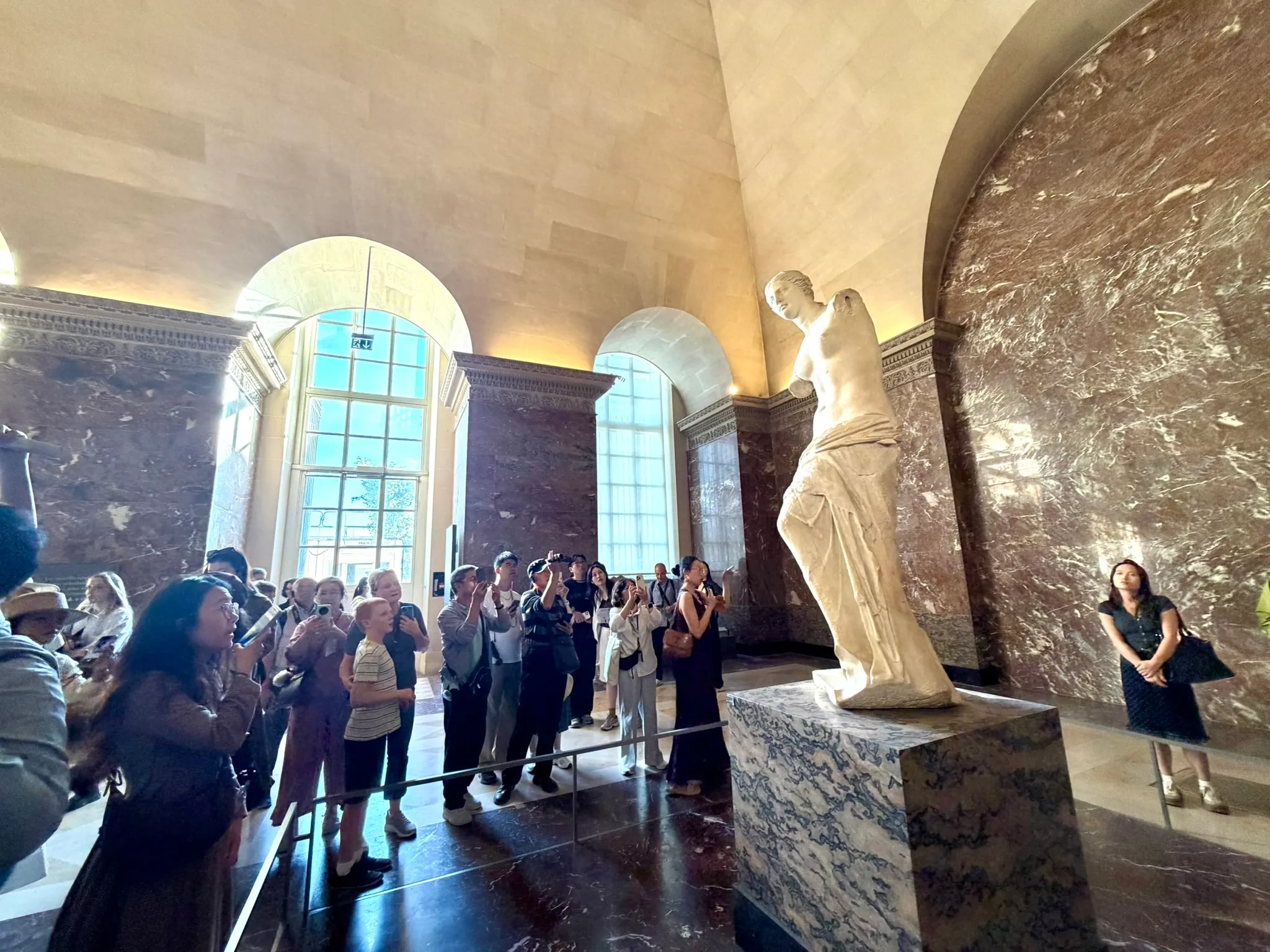
Louvre Masterclass III : The Venus de Milo and Greek Sculpture at the Louvre
This third Louvre Masterclass is devoted to the Venus de Milo and, more broadly, to the Greek sculptures displayed in the Louvre Museum’s Greek Antiquities galleries.
DATE & TIME
28 October 2026 at 18:15
MEETING POINT
Outside the group reception area, under the Louvre glass pyramid
DURATION
2 hours 30 minutes
LANGUAGE
French
THE PROGRAMME
This third Louvre Masterclass is devoted to the Venus de Milo and, more broadly, to the Greek sculptures displayed in the Louvre Museum’s Greek Antiquities galleries.
The session will offer an overview of Greek sculpture from its origins to the Venus de Milo, which will form the culmination of the visit and the subject of an in-depth study. We will explore the circumstances of its discovery, the history of its acquisition by the Louvre, questions surrounding its identification, and an analysis of its pose, drapery, movement and composition. We will also examine debates concerning its reconstruction and original appearance, before considering its critical reception during the twentieth century. These are questions that continue to shape our understanding of many ancient works of art.
Before turning to the Venus de Milo, the masterclass will examine several Greek sculptures displayed in the surrounding galleries, placing the statue within the broader history of representations of the human body in antiquity.
Participants will explore concepts such as the canon of proportions, contrapposto, idealisation, naturalism, movement, drapery, and the representation of divine and heroic figures, alongside the stylistic transformations that took place between the Archaic, Classical and Hellenistic periods.
Particular attention will be given to the ways in which these works were discovered, restored, collected and exhibited in Europe, helping participants understand how our contemporary perception of Greek sculpture has developed.
The session will also address the relationships between Greek originals, Roman copies and adaptations, and modern restorations — essential considerations when interpreting ancient sculptures preserved in major European museums.
Through close visual analysis and discussion, the masterclass will offer practical approaches to presenting Greek sculpture to different audiences, explaining works that are often fragmentary, and constructing engaging narratives without oversimplifying the historical and archaeological complexities involved.
YOUR VISIT
Practical information
Duration: 2 hours 30 minutes
Location: Louvre Museum — galleries or rooms specified in each masterclass programme
Language: French
Maximum group size: 20 participants
Audio headsets: Provided
Intended audience: Licensed tourist guides, cultural mediators and heritage professionals
Museum admission is not included. Participants must hold a valid form of admission to the Louvre, such as an admission ticket, a Friends of the Louvre membership card, a professional guide-conférencier card, or any other valid credential granting access to the museum’s collections.
YOUR ART HISTORIAN
Meet your expert
Guillaume Peigné is an art historian and lecturer specialising in Western art from the Renaissance to the Second World War. He holds a PhD in Art History, with doctoral research on nineteenth-century French sculpture. He has taught at the Sorbonne (Paris IV), the École du Louvre and Drouot Formation, where he continues to teach. His approach combines close visual analysis with historical context. At OMNI PARIS, he leads specialist museum masterclasses and professional training sessions.

JOIN THE MASTERCLASS
Reserve your place
Take a closer look at art and history with an expert-led OMNI PARIS masterclass.
Book this masterclassFor programme enquiries, contact us.